Sunday, November 14, 2010
Back to the Basics
There are weeks in the school year when I forget that my expectations for students exceed what they can give back. I was talking with my teacher friends and my mom who is a teacher and they all helped me remember to come back to the basics in the classroom. This week, we did just that. We needed to practice getting in line without shoving and pushing. We needed to remember what it felt like and looked like to read independently and with a partner. We needed to slow down. We needed time to play and reconnect with each other so that the routines in our classroom are stronger. Here is a video of a few girls creating during a morning play break. Their cooperation, excitement for creating and partnered conversation/explanation are helping each other learn through play.


Saturday, November 13, 2010
Stuck in the Mud by Jane Clarke

Do you know the story of The Enormous Turnip? Stuck in the Mud reminds me of this tale but with a twist at the end.
Little Chick is stuck in the mud and the animals on the farm are flustered over his predicament. His mother begins to pull him out only to get stuck herself. Then, many of the other farm animals follow her lead. By the end of this rhyming adventure, you come to find out that tricky Little Chick was never stuck in the first place. He jumps out of the mud and walks away from the whole mess!
The students and I shared a great conversation while reading this book by predicting events, rhyming text and the ending along the way. I also think there are other characters like Little Chick out there we can compare him to. The kids started to think about the duck, pig and cow in Mrs. Wishy-Washy because all of these animals and Little Chick enjoy the mud. I'll be trying to find primary characters that like to get others attention like Bossy Bear or characters that aren't so honest at first like Ruthie in Ruthie and the (Not So) Teeny Tiny Lie to help us begin to think deeper about these stories. Maybe you are thinking of some too?
Sunday, November 7, 2010
Mistakes
 (photo courtesy of Chelsea)
Last week as I was modeling how writers reread their writing ( I was demonstrating some editing I needed in my book that I wrote during our pattern book study) and notice when they need to fix punctuation. In my own book I purposely left out end punctuation, inserted an exclamation point in the middle of a sentence and drew a super large period at the end of a sentence all because this is what I am noticing kids doing in their writing. In the midst of kids noticing my crazy use of punctuation as they turned and talked to a neighbor, one student said in a louder voice than normal (I could see the light bulb turning on in her mind), "MISTAKES HELP YOU LEARN!!" Kids constantly surprise me. From this simple moment, this basic mini lesson, one little girl experienced a global idea. I am hoping she keeps taking risks and maybe I can find ways for her to connect this premise to other areas of her learning. Happy creating from your mistakes!
"Anyone who has never made a mistake has never tried anything new." Albert Einstein
Saturday, October 30, 2010
BLogging: How it Has Changed Me

Bill Gaskins of Creating a Path For Learning in the 21st Century has hosted a series of posts about the impact that blogging has had in the lives of educators. My post today is cross posted on his blog. Be sure to check it out the earlier reflections shared by librarians, consultants and teachers that were featured on his blog this week.
What has changed you as a learner? When reflecting back to my personal memories, there are a few times that stand out for me. Learning with my fourth grade teacher, Mrs. Green (because she believed in me), placing as regional runner-up for the Optimist Club’s Oratorical Contest as an 8th grader (which boosted my self esteem) and my student teaching experience with Steve Shack (working alongside a strong model) are all memorable moments in my life that have altered what I know about myself and what I have learned about teaching.
When asked to think about how blogging has transformed me as a learner and a teacher, my first thought is that it has developed my identity. Blogging has helped me feel like and take risks as a writer. I know that I am not the most the most profound or intellectual writer but I have come to feel like a person who has a message to share. A message that others will in turn offer feedback and reactions to my thoughts. I was not this empowered as a student. Though interested in learning, I found my place at the back of the classroom, a student who was nervous about saying something “wrong.” Blogging has allowed me to express my thoughts on topics that I feel strongly about: teaching, children and creative ways to enhance learning. So, first and foremost, blogging has given me a voice. A Year of Reading, Liz in Ink and MotherReader were a few of the first blogs that helped me find my own voice.
As a beginning blogger, I learned about bravery. I wrote what was on my mind wondering, would anyone read this or think it was worthwhile. I questioned my posts. Were they “good” enough? Was what I saying of value or did invite connections in my readers? I learned to let go of these thoughts, taking risks even when I was unsure of myself.
With more blogging, I am learning the value of collaboration. Sir Ken Robinson speaks of importance of collaboration in his presentation on Changing Paradigms. He talks about how “great learning happens in groups and that collaboration is the stuff of growth.” As a blogger, I find myself reading about ideas in posts, connecting with those ideas and then linking to them in some of my own posts. The excitement of collaborative learning drives me. I am inspired to hear from other bloggers who write about topics that are meaningful to me, comment about my connections or ask questions when I want to know more. Blogging also motivates me when I am posting about a topic that I am excited to share and receive feedback from other bloggers. With blogging, I am realizing how others thoughts (Weblogg-ed and Be Playful), questions and wonderings are expanding my understandings of the world. Blogging invites unending possibilities for collaboration.
Another significant lesson I have embraced as a blogger is the power of reflection. Reflection, as defined by dictionary.com, is “a fixing of the thoughts on something; careful consideration.” By blogging, I have entered into a realm of reflection that is deeper and public. Often, I take a happening or moment from my day at home or in the classroom and I think further about it by writing a post. Just by the act of first reflecting, I have found myself then experiencing something else: questioning. My own experience is similar to the process that Scott Filkins, editor of NCTE inbox, refers to in his post: The Value of Questioning in Professional Growth. Scott writes about his process of discovering his need to formulate questions within classroom situations and acting on those questions. Blogging has been that first stepping stone in my personal learning journey. It initiates my thinking about an idea, which then leads me to question that idea, and later to act on it in the classroom. With this process, bloggers like Cathy, Ann Marie and Julie have strengthened my ability to reflect, question and act on my own teaching.
Learning is not about right or wrong, rather, it is discovering what you love, searching for more and creating with what you are learning along the way. Blogging has allowed me to discover my own voice, dabble in collaboration, reflect then make changes in my own practice and share my love of teaching and learning with others. Next: How can I begin this learning journey with my own students ?
Wednesday, October 27, 2010
Writing Workshop: Pattern Book Study

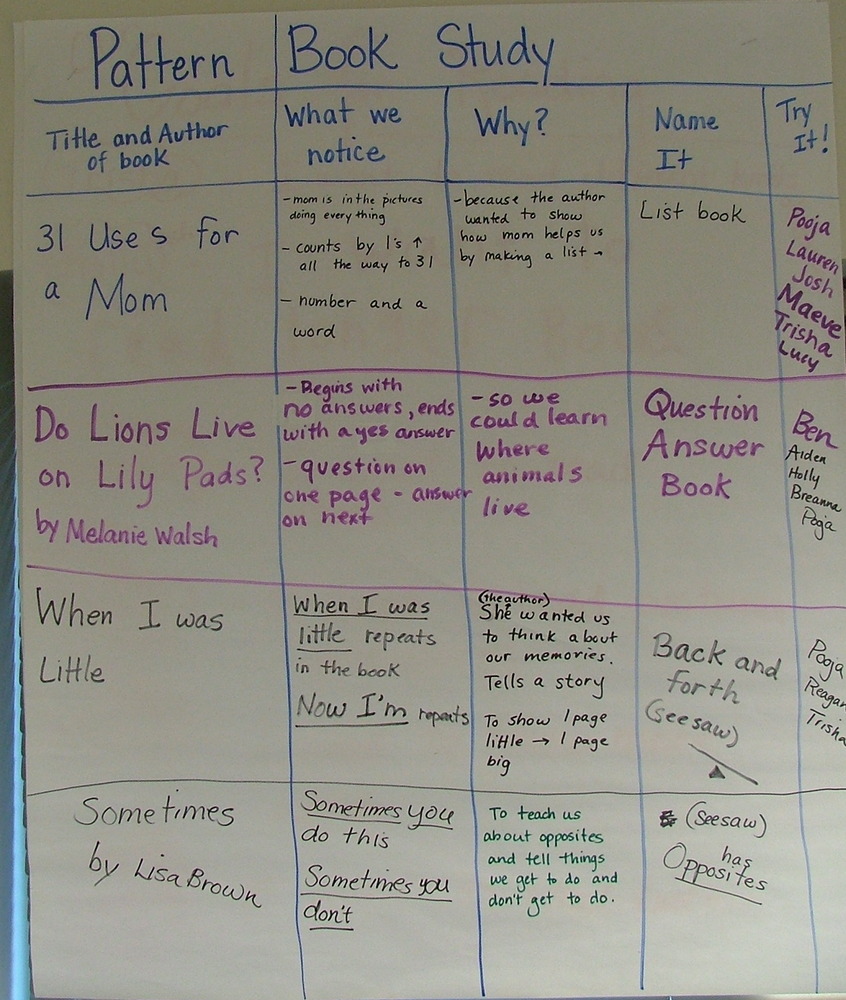 Stephanie Parsons has written a great resource for teachers called First Grade Writers. I especially love her unit of study on pattern books. This unit has helped my students begin to understand and feel successful noticing structures that authors and illustrators use to create a book. Studying different patterns connects so much of the thinkingwe are already doing as readers (noticing the repetition in text and the supports certain books have for early readers) and as mathematicians.
This month, I decided to use Stephanie's pattern study chart in my own classroom
with some of the books I thought would support writers. The kids have been creating books using the ideas from authors like Melanie Walsh's Do Lion's Live On Lily Pad's to create their own question answer books like Do Dogs Live in the Forest and Do dogs Live in the Park. Other students have created list books like 11 Uses for a Dog and 5 Uses for a Dad after studying 31 Uses For a Mom by Harriet Ziefiert. This study also allows all kids to enter the study. Students who are ready for more depth can use more sophisticated structures and other students who are beginning to understand patterns can create simple (that may just have repeating words and a clever ending) text and feel successful.
This week have started the practice of editing and revision while the kids have chosen one of these books to go back and fix up for publishing. I am so intrigued with how thorough this group

 seems to this year. They are teaching me to slow down and really spend time with this study. I can't wait to feel the energyduring our family night when the kids will share their books witheach other and all of our families.


Saturday, October 23, 2010
A New Primary Picture Book with Endless Possibilities

As, I used my 33% off coupon at Borders to day to buy, Back to Bed, Ed! the gentleman at the register (who told me was a former school librarian) commented about how much he loved the illustrations in this book. I couldn't help but feel the same way as when I first eyed the book a few weeks ago.
Being purposeful and opinionated about what books we like and dislike is so important to model for our students (as well as be able to support why or why not). I also love to make further connections to the work of authors and illustrators that I enjoy. I think it is important to model this when introducing first reads to students. So I searched for more to see what connections I could make to Sebastien Braun. I found out that Sebastien Braun has a wonderfully creative website that features his library (published work), his studio (his work in progress) and his loft (selections of his past work). He also has a 3-D link that features his pieces along with the mediums he used. I can't help but think about how kids could use website for art mentor ideas (I am thinking of my own sons who would love to create with recycled wood and acrylic paint).
Also, after perusing his site, I realized that I own another title he has written. So tomorrow I will also make known Meeow and the Big Box, which is in our cat book basket. I am happy to find out that Sebastien Braun wrote Meeow and the Big Box along with two other books in the" Meeow" series ( Meeow and the Little Chairs and Meeow and the Blue Table). So, I went right to the library to reserve them. The kids will not only find excitement in the one new book that I display but they will form connections with other books or ideas that we are thinking about. With these subtle connections, the excitement, learning and reading become heightened in the classroom.
Finally to why Back to Bed, Ed will be perfect for first graders:
First, Ed is young (preschool) like my students and often wants to sleep in his parents bed and many will likely have connections to this (go here for a quick synopsis of the story).
Second, the story will be a great independent read for some of my already transitional readers who need the thinking scaffolds that a picture book has to offer them.
Last, since this book has such a distinct character, I will put Ed's copied picture up on our rime wall. This word wall (really just an area on my cupboards) is delineated with the vowels. It helps me help kids build on many word concepts (we build words from common rimes, we talk about how versatile vowels are in our language (did you know the letter a makes like 31 sounds?), we learn the common "chunks" or rimes that are associated with the short and long vowels, I use it for guided writing to help make connections to sounds and rimes kids are learning with my help and kids use it during writing workshop to make connections to words they are writing independently). It is a very used wall of cupboards. This wall is in addition to our high frequency word wall that I have on the back of magnetic bookshelves. Ed will

help kids remember the "hard to remember" sound commonly known as short e (my own second grade son still struggles knowing what to write when he hears this sound).
Building connections in simple ways helps kids remember and understand. Why not use the authenticity of a picture book to help us teach everything about reading, writing and understanding words!
(here is part of our rime wall with Cat the Cat from Mo Willems' popular series and Jet (a little dog) from Joey and Jet by James Yang, another fun series my kids enjoy)
Monday, October 11, 2010
Labeling the Shelves

 My classroom library is filled with baskets of books. Books about superheroes, friendship, songs, cats, dogs, sports, trucks, family, animals and people. There are non-fiction baskets by topic, baskets of rhyming books, pattern books, math books and books sorted by author. Baskets work as an organizational tool, an anchor for partner reading, a tool for extending and building reading stamina and much more. Each time I read aloud a book (about 4-5 books a day), I talk about which basket the book comes from. I may model how to put it away or ask kids to think about which basket the book could be placed in.

In past years, the baskets seemed to make it back to the shelf in their "usual" spots. The author baskets made their way back to a shelf we designated for author baskets and the poetry basket fit in a little spot on the floor that was just the perfect size for it. This year, the baskets are not making their way back to their "usual" spots so I decided to help my kids by taping a copy of the basket label onto a specific spot in the shelves. I don't think I am ever totally satisfied with how the library works in my classroom. There is always something I can tweak each year with different groups of kids. My students this year seem to be thoughtful and careful about which baskets they return books ( I think because I spent quite a bit of time modeling this and having kids think aloud about how to return to baskets). I am hoping the labels help the baskets find their way neatly to the shelf so kids can get their hands on what they need more efficiently.
Subscribe to:
Posts (Atom)